Step by step
How the process works
Surgical assessment
We study whether surgery is the best option for your case, without rushing.
MIS intervention
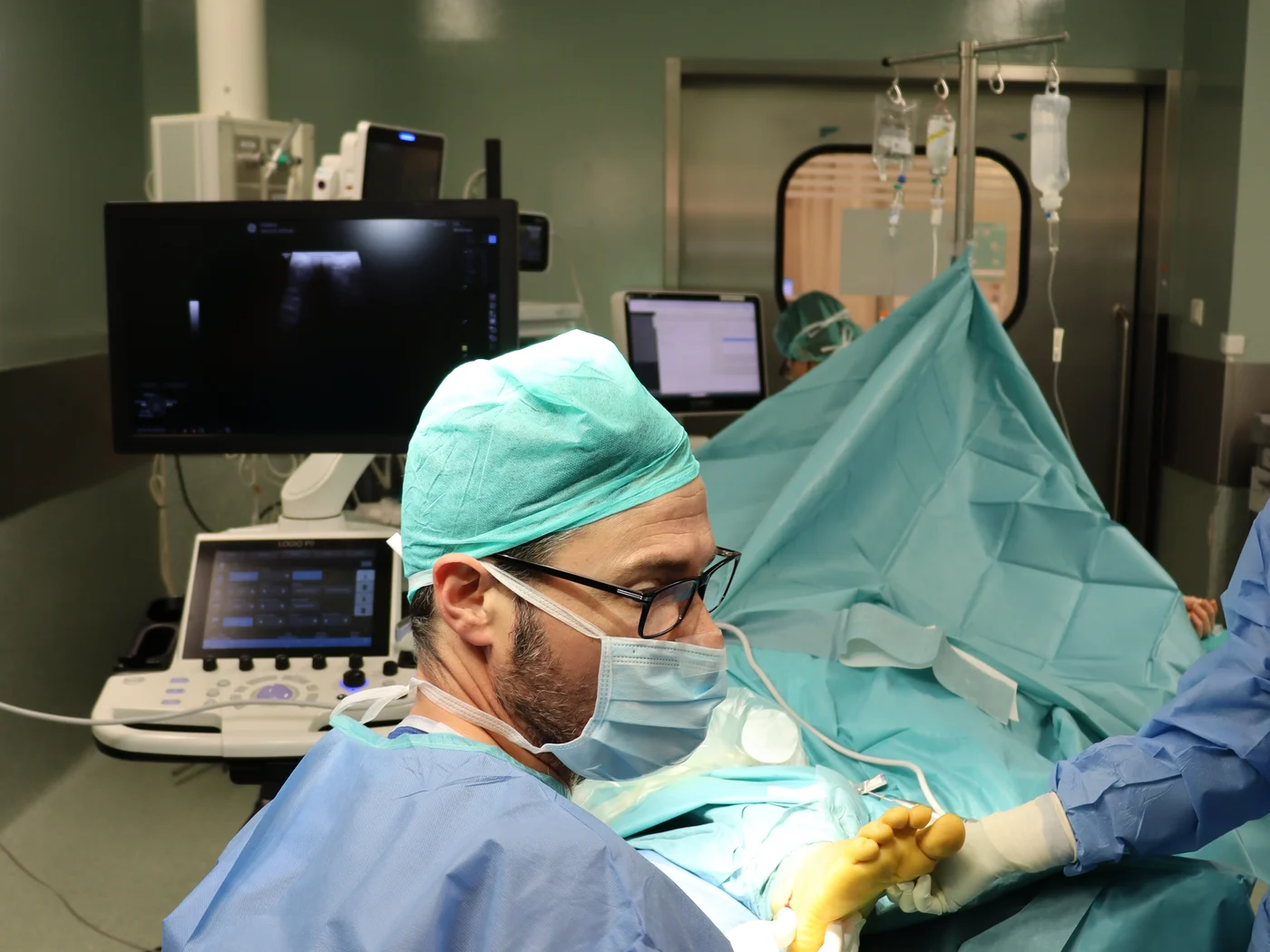
We operate using minimal incisions, often on an outpatient basis.
Supported recovery
We guide your recovery step by step until you return to your daily life.
What we work with
Technology we use
Objective diagnosis, not guesswork: this is the equipment we use to work on your case in Martorell.
Discover all our technologyYour case
Wondering if this treatment is right for you? We’ll assess it, no strings attached.
Tell us what you’re feeling and we’ll tell you the next step — no rush, no pressure.
Un trato excelente de todo el personal y muy profesionales.
Rocío G. C. · Google review
The full guide
What it involves
In summary: when foot surgery is necessary, the minimally invasive technique (small incisions) usually means less aggression and a lighter recovery. Not everything can be done with MIS: first we assess whether surgery is the best option. Dr. Serven operates at Teknon and Hospital d’Igualada.
Minimally invasive surgery (MIS) allows us to correct problems such as bunions or toe deformities with very small incisions. This usually means less tissue aggression and a lighter recovery.
Not everything can or should be operated on with MIS: first we assess whether surgery is the best option and which technique gives the best result in your case. We operate at Teknon and Hospital d’Igualada.
Percutaneous foot surgery: what exactly does it mean
Percutaneous foot surgery — often marketed as “laser surgery” — works through incisions of just a few millimeters, using specific instruments and image control during the procedure. There is no laser involved: there is technique, training, and a lot of practice.
The advantage is not just the small scar. By causing less aggression to the tissues, the postoperative period is usually smoother: less inflammation, less discomfort, and in most cases, walking from the first day with postoperative footwear. And all of it on an outpatient basis: you enter and leave on the same day, without admission.
For whom it is a good option (and when it is not)
The percutaneous technique gives very good results for deformities such as bunions, claw and hammer toes, and some causes of metatarsalgia, pain under the forefoot. If your case is a bunion, we explain it in detail on the bunion surgery page.
However, not everything can or should be operated on via a percutaneous approach. In very severe deformities or with advanced arthritis, an open or combined technique may offer a more stable and lasting result. The rule is simple: the technique is adapted to the foot, not the foot to the technique. If MIS is not the best option for you, we will tell you.
What makes this surgery different at Serven
First, the honest indication. Surgery is the last tool, not the first: if your problem still has room for improvement with conservative treatment, we will start there.
Second, the prior study. We assess the deformity, the X-ray, and your way of walking, using ultrasound at the first visit when it provides useful information. Operating without understanding the cause risks the problem returning.
Third, clarity. Before starting, you know which technique we will use, why we have chosen it, and what the fixed budget is. Dr. Serven operates at the Centre Mèdic Teknon in Barcelona and at Hospital d’Igualada, and has been dedicated to podiatry since 2005.
And fourth, the support. Percutaneous surgery does not end in the operating room: the planned postoperative care and follow-ups are part of the result, and we handle them until discharge.
Common questions
Frequently asked questions
Let’s take the first step together
We’ll explain your case, no commitment.