Bunion surgery
When the bunion hurts and progresses, we correct it with a minimally invasive technique — whenever the case allows — at Teknon (Barcelona) or Hospital d'Igualada.
Initial assessment to find out if you are a candidate — free of charge and commitment.
Step by step
How the process works
Surgical assessment
We examine the deformity, review the X-ray, and explain whether surgery is worth it — and if not, too.
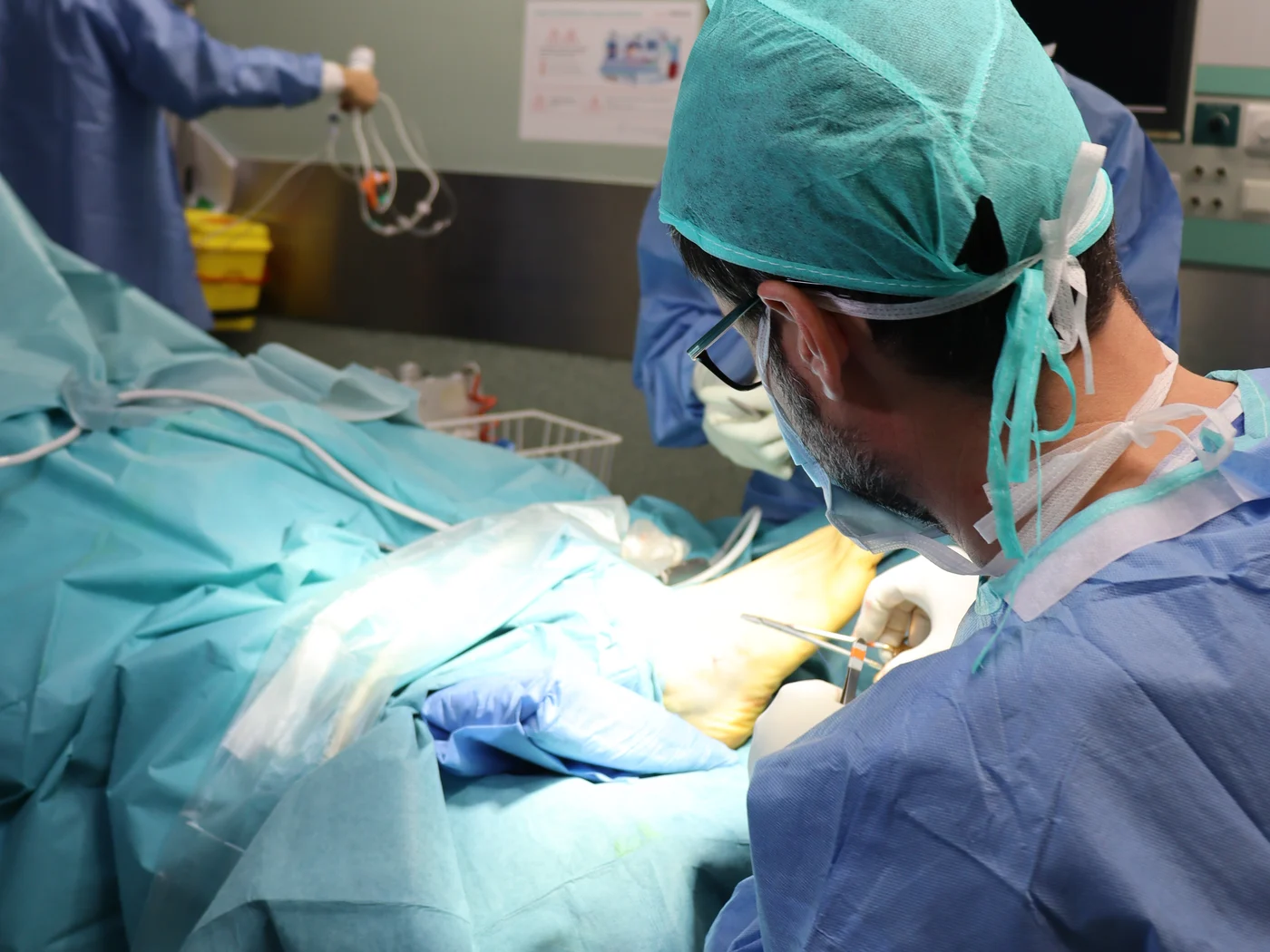
Intervention
Whenever the case allows, using a minimally invasive technique (small incisions), on an outpatient basis.
Guided recovery
In general, you walk from the first day with postoperative footwear; we monitor you until discharge.
What we work with
Technology we use
Objective diagnosis, not guesswork: this is the equipment we use to work on your case in Martorell.
Discover all our technologyYour case
Wondering if this treatment is right for you? We’ll assess it, no strings attached.
Tell us what you’re feeling and we’ll tell you the next step — no rush, no pressure.
Muchas gracias a Laura, la podóloga del centro, ya no es un problema caminar sin dolor, 100% recomendado el centro.
Jose Antonio A. M. · Google review
The full guide
What it involves
In summary: a bunion is operated on when it hurts or progresses, not for aesthetics. Whenever the case allows, we use a minimally invasive technique (small incisions), on an outpatient basis and walking from the first day with postoperative footwear. Dr. Serven operates at Centre Mèdic Teknon and Hospital d’Igualada.
Bunion surgery corrects the deviation of the big toe and the “bump” that causes pain with footwear. We never operate in a rush or for aesthetics: we first assess whether surgery is truly the best option for your case.
When it is, the minimally invasive technique allows correcting the deformity with very small incisions. This usually means less aggression to the tissues and a lighter recovery than with classic open surgery — although every foot is different, and we explain this to you without fine print at the assessment.
Who this operation is for (and who it is not for)
Bunion surgery is indicated when the bunion causes pain with everyday footwear, when the deformity progresses, or when it begins to affect the rest of the foot — for example, favoring claw or hammer toes or pain under the metatarsals.
It is not for everyone. If the bunion does not bother you and does not progress, often surgery is not necessary: with periodic check-ups and, if advisable, custom insoles to improve load distribution, that is enough. We also do not operate for aesthetics: surgery on a foot that does not hurt rarely compensates for what it involves.
And an important nuance: if what bothers you is stiffness and pain when flexing the big toe, it may not be a bunion but a hallux rigidus. These are different problems, with different surgeries. This is why the prior assessment is so important.
What the assessment includes before deciding
At the first visit, we examine the foot, review the X-ray, and, when it provides information, we use ultrasound to see the state of the soft tissues. We do not just look at the bump: we look at how you step and why the deformity has appeared.
With all this, we tell you clearly whether bunion surgery makes sense in your case, which technique we would use, and what you can realistically expect. If we believe it is not yet time to operate, we tell you that too. And before starting, you have a closed budget, without surprises halfway through.
Dr. Serven operates at Centre Mèdic Teknon in Barcelona and at Hospital d’Igualada, and has been treating the foot since 2005.
The recovery, explained without fine print
We will not give you a fixed deadline, because every foot and every person evolve differently. What we can do is explain the path: in general, with minimally invasive technique, you walk from the first day with a postoperative shoe, and the return to each activity — work, driving, sport — is scheduled progressively according to how your foot responds.
We do the follow-up ourselves, visit by visit, until discharge. If something does not evolve as expected, we detect it early and adjust the plan. Recovering well is not about rushing: it is taking each step at the right time.
Common questions
Frequently asked questions
Let’s take the first step together
We’ll explain your case, no commitment.